PREFERRED TIRE ROTATION PATTERNS Passenger & 4-Wheel and All Wheel Drive Light Truck
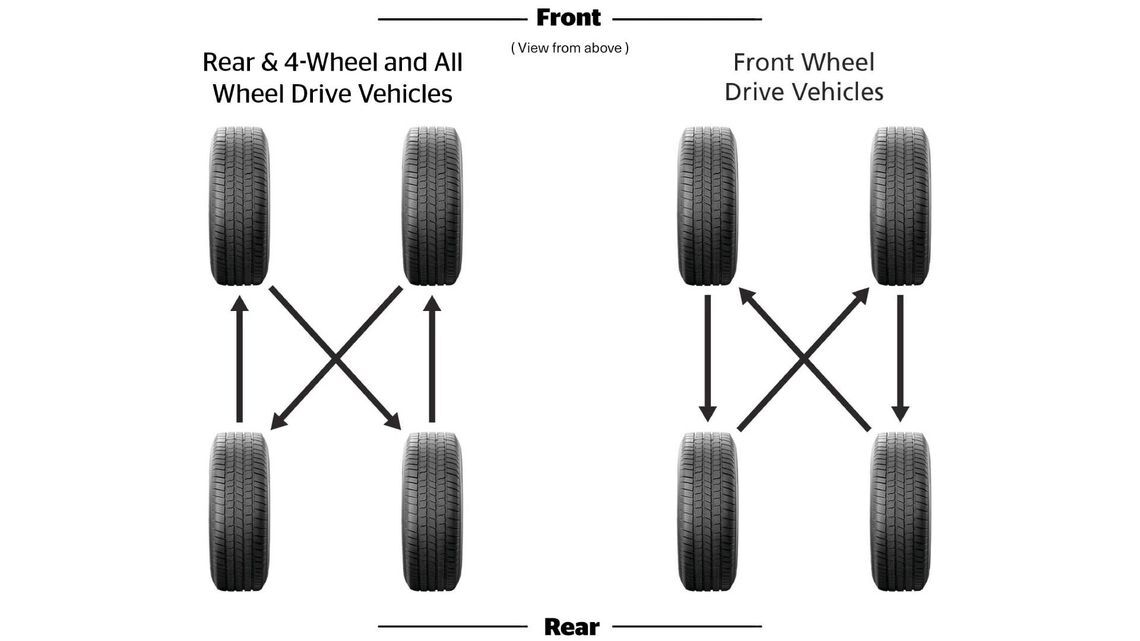
ALTERNATIVE TIRE ROTATION PATTERNS FOR ALL VEHICLES Passenger & 4-Wheel and All Wheel Drive Light Truck

TWO-TIRE ROTATION PATTERN Passenger & 4-Wheel and All Wheel Drive Light Truck
(Use only with the purchase of two tires or different tire sizes between front and rear axles)

ALTERNATE ROTATION FOR DIRECTIONAL TIRE WHEN DISMOUNTING TIRE FROM WHEEL IS NOT PRACTICAL

DUAL WHEEL ROTATION PATTERNS
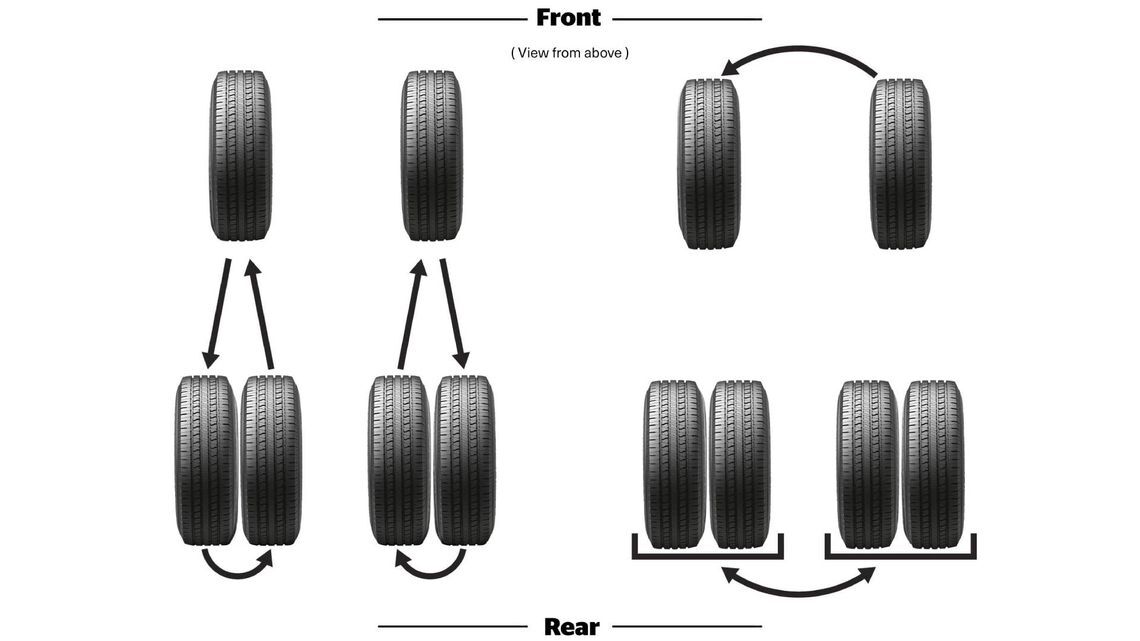
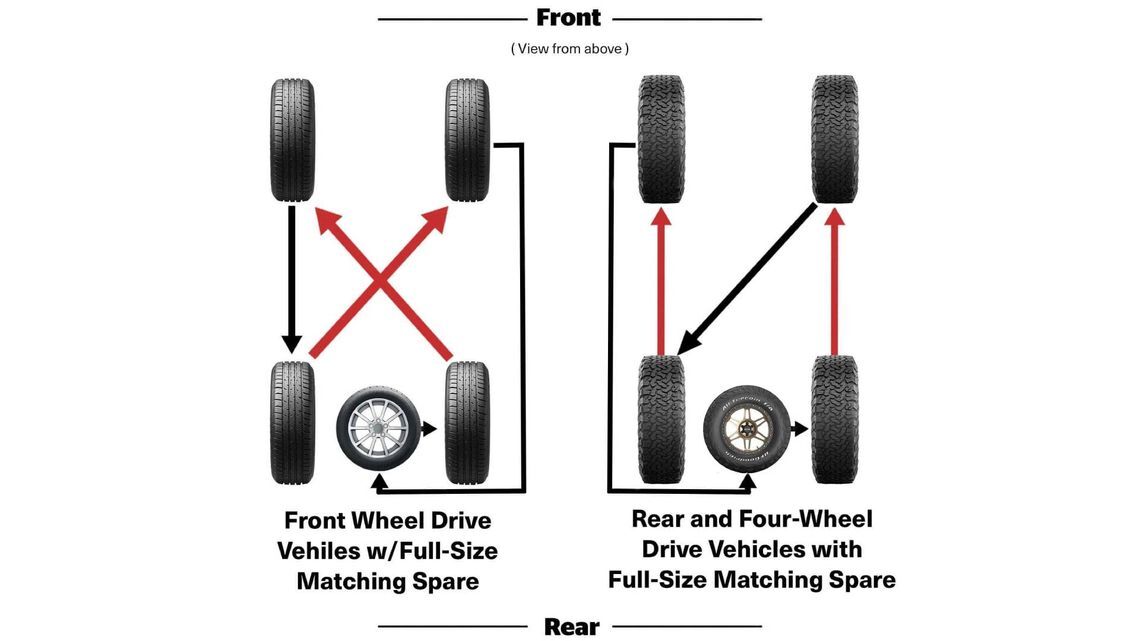
5 TIRE ROTATION PATTERNS
Frequently asked questions
BFGoodrich answers your most asked questions.
FAQ
Rotation means moving each tire and wheel assembly to a different position on the vehicle. Drive wheels and steering wheels take more punishment than the others, so without rotation two tires wear out long before the other two. Rotating spreads wear evenly, so the whole set reaches replacement together and you get more usable miles from each tire.
Every 6,000 to 8,000 miles, or 10,000 to 12,000 kilometers, unless your owner's manual specifies otherwise. Rotate sooner if you spot irregular wear developing. Some tire warranties require documented rotations at set intervals, so keep the receipts if your tires carry a mileage warranty.
On AWD all four wheels receive power and wear more evenly than on two-wheel drive, but rotation is still necessary. The typical pattern is a rearward cross or X pattern, moving tires between axles and sides. Because AWD systems are sensitive to differences in rolling circumference between tires, keeping wear even through regular rotation matters more on AWD than on other drivetrains.
Directional tires have an arrow molded into the sidewall showing the required direction of rotation. They can only move front to back on the same side of the vehicle, never crossed side to side, unless you dismount and remount them on the wheels. Always confirm the arrows point in the direction of forward travel after any rotation.
Yes, with a proper jack, jack stands, and a torque wrench. Never work under a vehicle supported only by a jack. Loosen the lug nuts slightly before lifting, lift and support the vehicle, swap the wheels to the correct pattern, then torque the lug nuts in a star pattern to your manufacturer's specification. Recheck torque after 50 to 100 miles.
Rotation redistributes wear but does not fix its cause. Wear on both shoulders points to underinflation. Center wear points to overinflation. Wear on one edge points to alignment. Cupping points to imbalance or worn shocks. Fix the cause first, or the same pattern repeats in the next position.
Related pages
Related articles
-

How to Change a Flat Tire
Changing a flat on the roadside is straightforward if you have practiced once in a driveway first. Before you need it, confirm three things are actually in your vehicle and functional: a spare that holds pressure, a jack, and a lug wrench. Then know the sequence: get safely off the road, loosen lugs before lifting, lift at the correct jacking point, swap the wheel, and torque the lugs in a star pattern.View more -

How to Check Tire Pressure
Tires can lose up to 1 psi every month even with no puncture, so check all four plus the spare once a month or before any long trip. Buy a trusted gauge, check cold before driving or at least three hours after, insert the gauge onto the valve stem, and compare the reading to the psi on the sticker inside your driver's door or in your owner's manual. Never use the sidewall number as your target.View more -

Products To Care For Your Tires
Nothing makes a car look sweeter than a shiny set of tires. But don’t put your investment at risk by using just any cleaner. Make sure to only use acid-free products. A number of wheel cleaners may contain harsh acids, alkalis and/or detergents that can damage wheels and paint. However, there are products out there that are safe for all brands of tires as well as environmentally responsible. You can find them at an auto parts dealer near you.View more -

Tire Balancing
Balancing compensates for weight variation in the tire and wheel assembly after mounting. A wheel is out of balance when one area is heavier or lighter than the rest, which causes bouncing or wobbling at speed. That vibration decreases treadwear, increases stress on your vehicle, and makes for an unpleasant drive. The fix is straightforward: correction weights are added to counterbalance the assembly.View more -

Tire Alignment
Alignment is the adjustment of your vehicle's front and rear suspension components, and it has to be correct. If the alignment is off, the vehicle is not safe to drive. Three angles are adjusted: caster, camber, and toe. Misalignment scrubs tread away, pulls the vehicle to one side, and makes steering imprecise. Potholes and rough railroad crossings are the most common causes of alignment drift.View more -

Tire Inspection
A monthly inspection takes five minutes and catches almost every problem before it becomes a roadside emergency. Check tread depth with the penny test or a gauge, look for the built-in treadwear indicator bars in the grooves, scan the tread for embedded nails and glass, and examine both sidewalls for cuts, cracks, and bulges. Do this on all four tires and the spare, at multiple points across each tire.View more